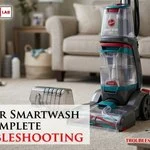
If your Hoover SmartWash Pet Complete won’t spray, won’t suck up water, or leaves the floor soaked, the fix is usually one of three things: a dirty or blocked nozzle, a full dirty-water tank, or a loose tank cap. Start by turning the machine off and checking the dirty-water tank is empty and clicked in, then run clean water through the nozzle to clear it. In most homes the real cause is a blocked nozzle filter.
Why the SmartWash Pet Complete stops working
The SmartWash Pet Complete has a few parts that clog or lose their seal, and most faults trace back to them. Dirty water gets pulled up with pet hair and carpet fibers, and that mix sets like wet lint inside the nozzle and the recovery path. When the path narrows, suction drops and the machine leaves the carpet wet.
The tanks are the second cause. The dirty-water tank has a float that rises when it fills. Once the float hits the top, the machine cuts suction on purpose. If the tank sits slightly off its seat, or the cap isn’t tight, the float sits wrong and suction stops early.
The third cause is the clean-water side. If the clean tank is empty or its valve isn’t seated, the machine runs but sprays little or nothing. That looks like a broken pump but usually isn’t.
Hoover publishes its own setup and care steps in the SmartWash Pet Complete user guide, and that guide is the page to check for your exact model number. It lists the tank positions and the nozzle removal step better than any general advice can.
Clear the nozzle and recovery path first
This fix is for the machine that sprays fine but picks up little water, or leaves streaks of wet behind. It’s the most common fault on a pet household carpet, where hair and dust bind together inside the nozzle.
- Switch the machine off and unplug it.
- Lift out both tanks and set them aside.
- Press the nozzle release and pull the clear front cover off the foot.
- Pull out any hair or fiber wrapped around the brush and the suction slot. Use scissors, not your fingers, on a tight wrap.
- Rinse the nozzle cover under a warm tap until the slot runs clear.
- Let the cover air-dry, then click it back until it seats.
Run the machine over a dry patch of carpet with no water spray for a few passes. If the carpet dries faster than before, the path was the problem. If nothing changes, the fault is upstream — go to the tank check.
This job needs no tools and no training. Stop and call Hoover support if the cover won’t release or you see a cracked housing, because forcing it can break the latch.
Check the tanks and their seals
This one is for the machine that cuts out mid-pass, or sprays nothing at all. Both tanks have to sit flat and click, and the caps have to be tight. A cap that’s a half-turn loose lets air in, and air kills suction.
Empty the dirty tank every time it reaches the full line — don’t wait for the float to stop the machine. Rinse it, then press the cap down firmly until it locks. On the clean side, fill to the marked line with warm water and the amount of solution the bottle states for a full tank, not more. Too much solution foams, and foam trips the float early.
Set both tanks in and press down until you feel them drop. Then switch on and hold the trigger for 3 seconds over a sink-safe spot. You should see an even spray and hear steady suction.
If the spray is weak but present, the clean tank valve is fine and the nozzle is the likely culprit. If there’s no spray at all, reseat the clean tank before you suspect the pump.
When to book a repair instead
Take the machine to an authorized Hoover service point when the motor runs but suction stays dead after a full nozzle clean and a tank reseat. That points to an internal seal or the suction motor, and both sit inside the housing. Opening the housing yourself voids the warranty and puts mains voltage near your hands, so leave it to a trained technician.
It’s worth the repair if the machine is still under its warranty, or if the fault is one part and the rest works well. It’s not worth it if the housing is cracked, the brush motor is also failing, or the quote comes close to the price of a new unit — check current prices at Hoover or a local retailer before you decide.
A machine that’s out of warranty and has two or more faults is usually a replace. A single blocked nozzle on a machine that otherwise runs well is a ten-minute home fix, so don’t pay a bench fee for that.
One mistake costs people the most here: dropping the machine off without asking for a diagnosis price first. Many service points charge a bench fee just to look at it, and that fee often isn’t credited toward the repair.
If the machine is under warranty, call Hoover first rather than driving to a service point. They can confirm whether the fault is covered and which centers are authorized near you, so you don’t pay for a repair the warranty would have handled.
If the quote lands above half the price of a new SmartWash Pet Complete, replace it. Below that, and with only the one fault, repair it.
SmartWash habits that cause more harm
Running over the same spot again and again with the trigger held. Extra solution soaks the pad and the carpet, and the machine can’t pull it back out. One slow wet pass and one dry pass is enough. On a spill that has already dried, pre-treat by hand and give it a few minutes before the wet pass.
Using more solution than the bottle says. More soap doesn’t clean better. It foams, trips the float, and leaves a sticky film that attracts dirt again. If the carpet still looks dull after one pass, the answer is a second dry pass, not a stronger mix.
Leaving dirty water in the tank between cleans. It sours and the smell spreads back onto the carpet on the next use. Empty and rinse it after every job. If you won’t run the machine again within a day or two, dump it the same evening.
Pressing the nozzle cover on hard to force it. The latch is plastic and cracks. If it won’t click, check for a trapped fiber rather than pushing harder. A cracked latch means a new cover, so look before you lean on it.
Storing the machine with a full clean tank. Solution sits in the line and dries into a clog. Empty it before you put the machine away. Run a little clean water through the line first if the machine has sat for weeks.
Keep the SmartWash Pet Complete running
A short routine after each use does more than any repair. Empty and rinse the dirty tank, flush a cup of clean water through the nozzle, and wipe the brush slot. Then store the machine with both tanks off and dry.
| If you’re doing this | Do this instead | Why |
|---|---|---|
| Holding the trigger on one spot | One wet pass, then release and do a dry pass | Stops the carpet soaking past what suction can lift |
| Filling the clean tank to the top with solution | Water to the line, solution at the bottle’s stated dose | Less foam, so the float doesn’t trip early |
| Leaving the dirty tank until next time | Empty and rinse it right after each clean | Stops smell and buildup in the recovery path |
| Skipping the nozzle rinse | Flush clean water through the cover after every job | Keeps hair and fiber from setting in the slot |
| Storing with tanks fitted and full | Remove both tanks and let them air-dry | Prevents clogs and mildew between uses |
Related guides
Frequently asked questions
Why is my SmartWash Pet Complete not spraying water?
The clean-water tank is the first thing to check. Make sure it’s filled to the line, seated flat, and its cap is tight. If the tank is fine, the nozzle slot is likely blocked with hair. Pull the cover, rinse it, and test again. A pump fault is rare and only worth suspecting after both checks fail.
Why won’t my SmartWash Pet Complete pick up water?
A full dirty-water tank or a raised float stops suction on purpose. Empty the tank and reseat it until it clicks. If it’s already empty, clean the nozzle and recovery slot — hair bound with dust narrows the path and kills lift. If suction is still dead after both, it needs service.
How often should I clean the nozzle?
Clean the nozzle after every use in a pet home, and at least once a week if you clean carpets only now and then. Pet hair sets fast once it dries. A 2-minute rinse after each job prevents most suction faults, and it costs nothing but a little warm water.
Is it safe to use the machine with the tanks not fully clicked in?
No. A tank that isn’t seated lets air into the system, so suction drops and water can spill onto the motor area. Always press each tank down until you feel it lock before you switch on. If a tank won’t click, check for a trapped seal or debris in the seat.
What happens if I use too much cleaning solution?
The machine foams, the float rises early, and suction cuts out before the tank is full. Foam also leaves a sticky residue that pulls dirt back onto the carpet. Use the dose the bottle states for a full tank, and no more, then rinse the nozzle with plain water.
Can I fix a SmartWash Pet Complete myself?
Yes for the common faults — a blocked nozzle, a full tank, a loose cap, or a tank that isn’t seated. Those are all home checks with no tools. Anything inside the housing, like a motor or internal seal, needs an authorized Hoover service point. Don’t open the housing yourself.
How long should a carpet take to dry after cleaning?
Most carpets feel dry in about 4 to 6 hours with good airflow, assuming one wet pass and one dry pass and a warm room. Damp or cool weather stretches that. If the carpet is still wet the next day, the machine isn’t lifting water — clean the nozzle and check the tank seal.
Conclusion
If those fixes don’t do it, grab your manual and check the troubleshooting chart for your specific model, or call Hoover support before your warranty runs out. You’ll likely sort it out in a few minutes, and you can get back to clean floors without the guesswork.